Beyond Chatbots: How Autonomous AI Agents Are Redefining Enterprise Workflow Automation
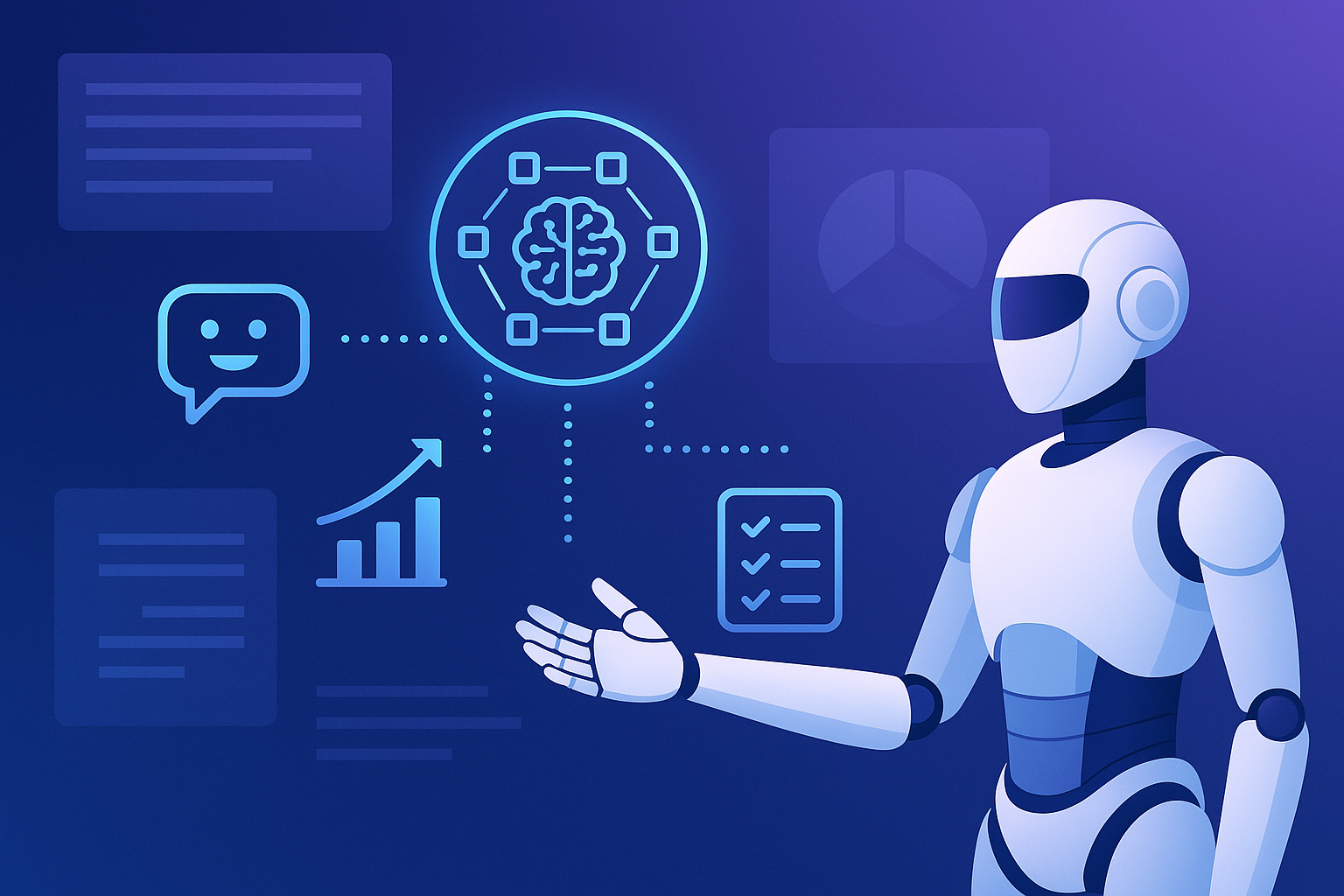
Most companies treat generative AI like a new UI widget – drop in a chatbot, check a box, move on. The next wave is not smarter chat; it’s autonomous AI agents that orchestrate tools, data and decisions across workflows. Plainly stated: custom AI product development is no longer a luxury for R&D teams. It’s the operational backbone for enterprises who want measurable automation at scale. Keval.ai demystifies this path with a clear 5-step execution process: Discovery → Rapid Prototyping → MVP → Deploy → Scale.
The Keval.ai 5-Step Roadmap
- Discovery – Map stakeholders, data sources, SLAs and risk tolerances; define success metrics.
- Rapid Prototyping – Build lightweight agent prototypes to validate integrations, latency and user flows.
- MVP – Harden the prototype with security, monitoring and fallback logic for limited production use.
- Deploy – Roll out with real users, operational runbooks, and cost controls.
- Scale – Optimize models, routing, observability and governance to expand across teams and processes.
This process is deliberately iterative: each stage reduces unknowns that traditionally inflate timelines and budgets for custom AI projects.
Avoiding Common GenAI Pitfalls
Enterprises that rush to deploy generative systems stumble on four common issues: latency, API cost, model hallucination and scope creep. A disciplined execution model turns these risks into manageable engineering problems.
- Latency management: Design pipelines that combine cached embeddings, local prefilters and async orchestration. During Rapid Prototyping, validate end-to-end latency budgets so the MVP doesn’t surprise users.
- API cost optimization: Route requests based on cost/latency trade-offs – cheap models for classification, premium models for synthesis. Implement token budgets, response truncation and query batching early in Deploy to control spend.
- Model hallucination: Use retrieval-augmented generation, provenance tagging and confidence thresholds. In Discovery and Prototyping, test hallucination rates against your domain corpus and add human-in-the-loop checks where needed.
- Scope creep: Freeze a narrowly defined set of workflows for the MVP. Use the Scale step to expand scope deliberately, with new acceptance criteria and governance changes.
Speed vs. Quality: Rapid Prototyping Without Sacrificing Enterprise-Grade Security
Fast prototypes don’t have to be fragile experiments. Speed and enterprise-grade quality are complementary if you adopt the right trade-offs during each stage of the Keval.ai process.
- Rapid Prototyping: Use mocked connectors and synthetic but representative data to validate functionality fast. Keep secrets and PII out of prototypes by design.
- MVP: Harden the prototype with authentication (SSO, OAuth), encryption-in-transit and at-rest, role-based access and audit logging. Build observability (metrics, traces, error budgets) so operational risks are visible before scale.
- Deploy & Scale: Add threat modeling, compliance checks and adversarial testing. Automate rollback paths and circuit breakers to maintain reliability under failure modes.
The Keval.ai approach sequences security and reliability work where it matters: quick validation first, then hardened production readiness – never the other way around.
Choosing the Right Tech Stack: Fine-tuning vs. RAG vs. Agentic Tool Orchestration
There’s no one-size-fits-all. The right architecture depends on data volume, required determinism, latency tolerance and the complexity of tasks your agents must perform. Here’s a pragmatic comparison.
| Approach | Best for | Pros | Cons |
|---|---|---|---|
| Fine-tuning | High-volume domain data, deterministic outputs | Lower inference cost per call, more consistent outputs | Longer iteration cycles, retraining costs |
| RAG (Retrieval-Augmented Generation) | Dynamic knowledge bases, compliance-heavy domains | Grounded answers, easier updates to knowledge | Extra infrastructure for index/update; retrieval latency |
| Agentic tool orchestration | Multi-step workflows requiring external actions (APIs, DBs, apps) | Automates complex processes, composes tools | Harder to test; requires robust error handling and safety checks |
Practically, hybrid architectures win: RAG to ground knowledge, lightweight fine-tuning for domain-specific behavior, and agentic orchestration to stitch tools together. Keval.ai’s stepwise process ensures you prototype the right combination early, then optimize during Deploy and Scale for cost and latency.
A Fair Objection and Why It Doesn’t Derail the Case for Custom Agents
Objection: “Why not buy a turnkey chatbot from a vendor? Custom agents are expensive, slow, and introduce governance headaches.”
This is a valid concern. Off-the-shelf solutions reduce immediate friction and can be suitable for simple use cases. But the trade-offs such as limited integrations, opaque behavior, poor fit to business rules, longer-term vendor lock-in and lack of measurable ROI are real.
Rebuttal: The Keval.ai 5-step process minimizes the very risks critics cite. By validating assumptions in Discovery and Rapid Prototyping, you avoid large sunk costs. The MVP stage enforces security and compliance guardrails before broad exposure. And the Scale phase focuses on operational cost controls and governance – precisely the areas that make bespoke solutions worth the investment when automation drives critical outcomes. In short: buying convenience buys limits; building deliberately buys leverage.
Conclusion: Start Small, Plan Big
Autonomous AI agents are not a bolt-on feature; they are a new operational layer. The fastest way to get value is to treat custom AI product development like any other enterprise initiative: uncover assumptions early, prototype with purpose, harden for safety, and scale with metrics. Keval.ai’s Discovery → Rapid Prototyping → MVP → Deploy → Scale blueprint converts the mystique of “AI” into an execution playbook that reduces risk and accelerates ROI.
If your organization wants to turn generative AI from a novelty into dependable automation, the question isn’t whether to build agents, it’s how fast you can move through the five steps with discipline, governance and measurable outcomes.
Leave a Reply